Stateless vs Persistent Agent Design Tradeoffs
Where you store agent state determines which tasks it can actually perform.
Every large language model API call starts from zero, with no memory of anything that happened before it. That single fact is the root of nearly every hard problem in agent engineering, because the tasks people want agents to do are inherently stateful, while the model answering the call is not. What most SDKs sell as "chat memory" is not memory at all. It's the developer's own code, quietly re-sending the entire prior conversation with every new request, while the model itself forgets everything the instant the response is generated. So the decision about where state lives, inside the prompt, in a database, in an external memory store, isn't a matter of code cleanliness or personal preference. It decides outright which tasks the agent can perform, and which it structurally cannot, no matter how the prompt is worded.
Stateless agents and the class of problems they handle well
A stateless agent treats every request as a closed transaction. Input comes in, a prompt gets built, the model responds, and nothing survives past that response. Whatever context the agent needs for the task has to be packed into the prompt itself, because there is no other place for it to live; the agent exists, as one industry source memorably put it, "in an eternal present moment". That sounds like a limitation, and in some cases it is, but for a specific and quite large category of work, it's exactly the right shape.
Classification, code explanation, single-turn question answering, document summarization: these are one-shot tasks where each request is self-contained. For that category, statelessness is a feature. Stateless agents scale horizontally with close to perfect efficiency, because no session is pinned to a particular server or instance; any available worker can pick up any request, since nothing has been persisted that ties the interaction to a specific machine. That is why stateless calls are so easy to reproduce and cache. Benchmarks like SWE-bench use isolated, self-contained task instances specifically to make results reproducible, but that's a property of the benchmark's task design, not proof that stateless invocation is how real agents run, and AgentBench in fact leans on multi-turn, interactive environments to test agents at all. The distinction matters because it's easy to conflate "the task was self-contained" with "the agent had no state," and those are different claims.
There's also a latency dividend that gets underappreciated. A stateless call has no state to load before it can start reasoning, so on short, self-contained tasks it responds faster than an architecture that has to reconstitute a memory store or replay history first. And stateless deployments sidestep an entire category of operational pain: migration. Swap out the model, restructure the database schema, redeploy the service, and nothing breaks, because there was never anything sitting in storage that depended on the old shape of things. For teams building narrow, well-scoped tools, that simplicity is the correct architecture. It's the correct architecture.
The structural ceiling of stateless design on multi-step and long-horizon tasks
The trouble starts the moment a task stops being one-shot. Early agent developers, facing multi-turn conversations, reached for the obvious fix: dump the entire history into the context window on every call. It worked for a while, and then it stopped working, because it doesn't scale. Latency climbs as the prompt grows, and worse, the model's ability to actually use what's buried in that history degrades, a phenomenon researchers call "lost in the middle." Stuffing retrieved memory into a giant context window pays the same attention tax as stuffing in a raw transcript. Moving the state into the window doesn't solve the problem, it just relocates it.
There's a compounding cost on top of that. In a genuinely stateless multi-turn setup, the client has to re-send the full conversation with every new request, so the prompt grows with every turn and the token bill grows right along with it, a pattern sometimes called the snowball effect. That's expensive, but it's not the deepest issue. The deepest problem is continuity across sessions, which stateless design cannot provide at all, not partially, not with workarounds. A research agent that's supposed to accumulate findings over several days starts every session blank. A customer support agent that's supposed to remember a customer's prior ticket has no way to know one exists. Every session is a fresh present moment, and the agent has amnesia by construction.
Human-in-the-loop workflows expose the same flaw from a different angle. A task that pauses to wait for a manager's approval, or that runs long enough to hit a timeout or a rate limit, needs some way to resume exactly where it left off. Stateless design offers nothing. Whatever completed before the pause has to be re-run from scratch, which is wasteful at best and dangerous at worst if any of that work had side effects. This is precisely the gap that one industry source, Tacnode, points to directly: the next real jump in what agents can do won't come from bigger models or more training data, it will come from solving state. The failure modes here (stale state from parallel overwrites, partial updates that leave the agent in an inconsistent position, race conditions between competing tool calls, and prompt drift as context degrades over long runs) are the exact failures that occur once an agent moves off the happy path of a single self-contained request, and that is where the entire architecture conversation is heading.
The five architectural patterns for building persistent state into agents
Persistent design isn't one technique bolted onto a stateless model. It's a spectrum of five distinct patterns, and each one solves a different failure mode from the section above, so choosing among them is less about preference and more about diagnosis.
The first is the in-context working buffer, the agent's short-term scratch space for whatever session is currently running. It's a sliding window that, as the token limit gets close, compresses older turns into a background summary and then flushes the whole thing once the session ends. Every agent that does more than one step needs this, since it is the baseline layer beneath everything else. Summarizing mid-conversation rewrites the prompt prefix, and rewriting the prefix invalidates the KV cache, which causes a latency spike on the very next call. That's not a bug to be fixed later; it's a structural tradeoff of the pattern itself.
The second is execution checkpointing, which answers the human-in-the-loop and long-running-task problem directly. Workflow state gets written to a durable store, Postgres or SQLite in most implementations, after every node completes, so if execution stops, it resumes exactly where it left off instead of re-running finished work. Graph-based agent frameworks model this naturally, since a workflow is already a graph of nodes and edges, and the state is just the variables, the history, and the current position in that graph. Checkpointing gives resumability, not exactly-once guarantees. A node that sent an email or wrote a database row before a crash may run again once the workflow resumes, so any side-effecting node has to be built to tolerate being executed twice. And not everything can be checkpointed at all: open file handles and live client objects don't survive serialization, which is a real constraint on what's allowed to live inside state.
The third pattern, semantic memory, handles continuity across sessions: facts, preferences, and domain knowledge that need to persist even after the current session closes entirely, usually stored in a vector store, sometimes paired with a knowledge graph. Facts get pulled out of the conversation asynchronously and injected back into the prompt at query time. It's retrieval, not replay, which is a meaningfully different operation from re-sending a transcript. The design issue to watch for is conflict. If someone tells the agent "I use Postgres" in March and "we migrated to Snowflake" in July, both statements end up sitting in the store, and without an explicit rule that the newer fact wins, the agent may quietly act on the stale one. Depending on how the pipeline is built, that extraction step can also cost an additional model call on every turn, and that cost should be accounted for up front rather than discovered in a bill.
Episodic memory is the fourth pattern, and it's a narrower cousin of semantic memory: rather than storing facts, it stores records of past task runs and the decisions the agent made along the way, so the agent can recognize a similar task later and avoid a mistake it already made once.
The fifth pattern isn't about remembering more, it's about stopping soon enough. Constrained execution with guardrails puts hard bounds on loop iterations, tool call budgets, and output validation, specifically to prevent an agent from running away on cost or taking an unsafe action. One industry source, Mastra, frames this bluntly: an agent that never stops isn't autonomous, it's a bug that happens to generate a token bill, and the fix is to put an iteration limit on every loop before it ships. Broken state means the agent loses track of what step it's on mid-task. Broken memory means it can't learn, personalize, or bring anything forward from an earlier session. Different symptoms, different patterns, different fixes.
Isolation infrastructure determines whether persistent state is safe to run
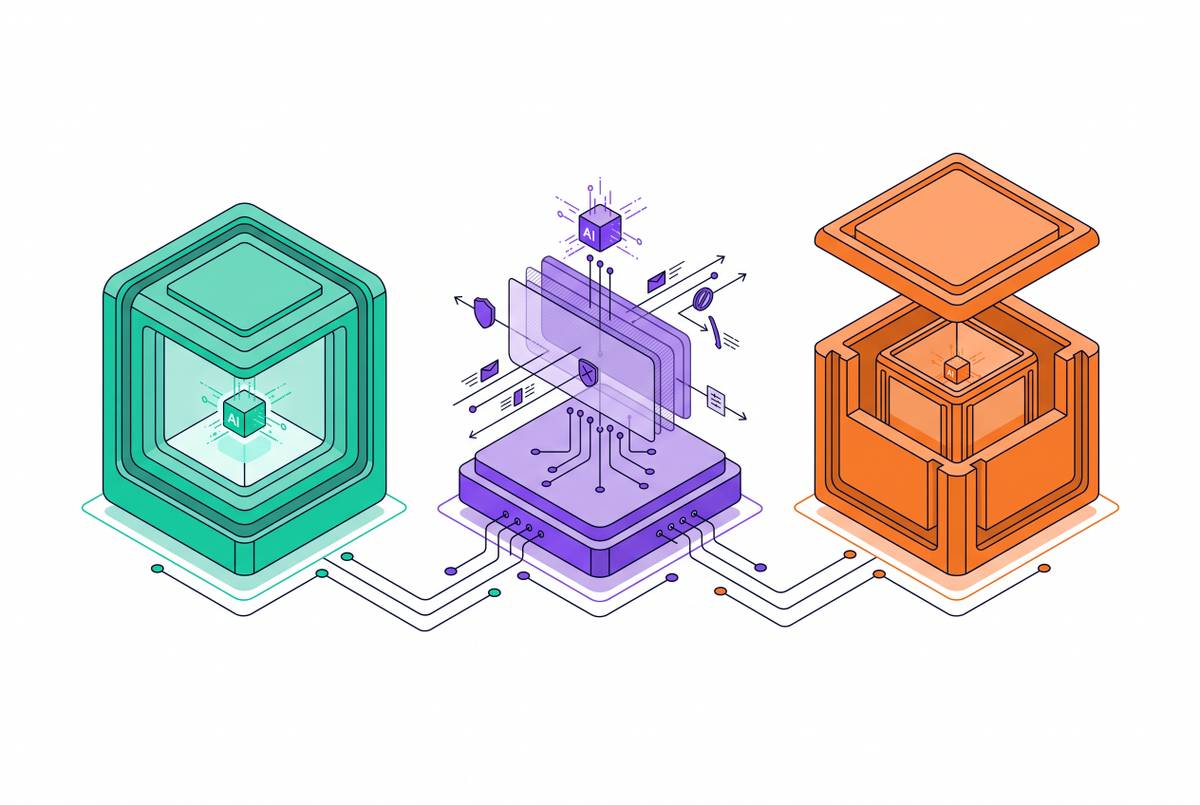
Persistent agent design is not a single pattern but a spectrum of five approaches, each addressing a different scope of state and a different failure mode. This isn't a performance tuning question, it's a security question, and the right answer depends entirely on the agent's capabilities. A text-only agent with no tool access and nothing persisted can run safely in a standard container, or in something like gVisor, because there's little for an attacker or a bug to reach. The moment an agent starts executing code, installing packages, or talking to the network, that calculus changes, because a shared kernel means one agent's crash, or one agent's exploit, can spill over into every other workload sharing that kernel. That calls for a microVM, not a container.
The consequences of getting this wrong aren't hypothetical. CVE-2026-21858, found in n8n, traces back to missing input validation in how the platform handled webhook requests, a Content-Type confusion bug that let an unauthenticated attacker reach files and execute code remotely. That's an architecture and validation failing, not a model failing, and it's exactly the kind of incident that isolation boundaries exist to contain.
Firecracker has become a common answer to this problem because its numbers make per-request isolation economically realistic rather than a theoretical ideal. The OpenAI Agents SDK overhaul in April 2026 addressed a chunk of that tax directly, introducing native sandbox execution so teams no longer had to hand-wire runtimes, lifecycles, and crash handling themselves.
A community benchmark run that same month compared four sandbox products, SmolVM, E2B, OpenSandbox from Alibaba, and Microsandbox, across six criteria. E2B led on one, the maturity of its SDK ecosystem. No single product swept the board, which is the honest picture: the isolation layer is still a genuine tradeoff space, not a solved problem with one obvious winner.
Snapshot-restore scheduling and the affordability of persistent, isolated agents at scale
Strong isolation sounds expensive, and for a long time it was, because the naive way to run a microVM per request or per agent is to keep it warm and idle between uses. That's the idle tax: an agent spins up an environment, runs one command, then sits there waiting, waiting on the next model response, waiting on a human to approve something, waiting in a queue. If the isolation layer is slow to create, the only way to avoid paying that creation cost on every request is to leave the machine running, reserving CPU and memory the whole time, billing for nothing but the privilege of sitting still. Multiply that across a platform with many mostly-idle tenants, and the idle tax can dwarf the cost of the actual work being done.
Fast snapshot-restore breaks that equation. At that speed, there's no need to keep anything running just to avoid a slow cold start. The cost shifts from paying for idle compute to paying for stored snapshots, which is a fundamentally cheaper thing to hold onto.
That speed threshold turns out to be a security decision as much as a performance one. When spinning up a fresh, disposable environment per request or per agent step is cheap enough, cross-contamination between tasks becomes structurally impossible, because nothing sticks around long enough to leak. When cold starts are slow instead, teams end up keeping instances warm just to hit a latency target, and in doing so they quietly accept a weaker isolation guarantee because a latency number forced their hand, not because they evaluated the threat model and decided it was acceptable.
Most real products land somewhere in the middle: long-lived environments scoped to a single tenant that scale down to nothing when that tenant goes quiet. The tenant's state and installed dependencies stay intact, while the operator stops paying for compute the moment nobody is using it. PandaStack calls this pattern auto-hibernate: the machine gets snapshotted, released, and restored automatically the next time a request for it arrives. Sprites takes a similar approach with Firecracker microVMs, running auto-sleep and charging nothing for idle compute, though storage and the underlying monthly plan fee still apply; the platform also added native MCP endpoint support in March 2026. Firecracker's minimal device model is part of why this works as well as it does: less virtual hardware to emulate means less state to serialize, so snapshot and restore end up both faster and more predictable, which is the same architectural choice paying off twice. That same infrastructure supports a clean operational pattern for sandboxes that need to run arbitrary or untrusted code: checkpoint right before execution, then restore to a known clean state right after, using the identical snapshot mechanism that makes hibernation cheap. PandaStack reports no warm pool of idle VMs, with every create restoring a baked Firecracker snapshot at p50 179ms and p99 roughly 203ms, and a snapshot-load step around 49ms.
The cost of persistent agent infrastructure and where the breakeven sits
None of this can be built if a team can't tell in advance whether it's affordable, and the good news is that the economics here are more predictable than the architecture questions that came before them. Per-token model pricing has stopped being the variable that decides how an agent gets built, largely because managed runtime pricing across the major clouds has converged. Microsoft Foundry, Bedrock AgentCore, and Vertex AI Agent Engine are all in a similar band of vendor-stated pricing, and Anthropic's own managed agent offering is in that same public-beta neighborhood. When the big providers charge roughly the same for compute, the architecture decision is not about which vendor is cheapest but about which pattern actually fits the task.
The bigger lever, by a wide margin, is prefix caching. Reusing a cached key-value store for a prompt prefix that doesn't change turn to turn cuts time-to-first-token substantially and lowers per-call cost by a meaningful margin, and while the exact numbers differ across vendors and academic benchmarks, the direction is consistent everywhere it's been measured.
Workflow orchestration costs get misread constantly, usually in the direction of assuming they're bigger than they are. Take Temporal Cloud as a concrete example: for a startup in its first year, platform fees are modest next to what the same workload spends on model tokens. A ten-turn agent making one model call and one tool call per turn burns well under one percent of its total token spend on orchestration platform fees. Where the real orchestration cost hides is in things teams tend to overlook: heartbeats from long-running tool calls, UI polling loops, and the worker fleet a team still has to run and maintain itself.
The harder question is whether to rent this infrastructure or build it in-house, and the honest answer is that the breakeven moves. It is roughly at the point where sustained utilization reaches a meaningful fraction of a compute slot's capacity; below that line, renting wins outright, and the exact point where that flips depends heavily on how strict the resume-latency requirement is and whether GPU access is part of the equation. There's no single number that applies everywhere, which is itself the useful takeaway: the decision has to be run as a calculation specific to the workload, not assumed from a rule of thumb.
Zooming out, the pricing pattern across the wider AI product market in 2026 tells a related story. Productivity tools charge per seat, APIs charge by usage, customer support products increasingly charge by outcome, and multi-purpose platforms use hybrid models (when agents do more work, costs shift from headcount to compute, tooling, and oversight, and if a startup's pricing does not match that shift, it breaks quietly). As agents take on more of the actual work, the underlying cost structure shifts away from headcount and toward compute, tooling, and the oversight needed to keep an autonomous system in check. A pricing model built for the old cost structure doesn't collapse loudly when that shift happens. It just quietly stops making money, one contract at a time.
Sources
- 5 Architectural Patterns for Persistent Memory and State in AI Agents - MachineLearningMastery.com
- AI Agent Architecture: Patterns and Production Design | Mastra Articles
- Stateful vs. Stateless Agent Design: Tradeoffs for Scalable Agentic Systems - MachineLearningMastery.com
- Stateful vs Stateless AI Agents: A Practical Comparison | Tacnode Blog
- Stateful vs Stateless AI Agents: Architecture Patterns That Matter
- Firecracker