Designing Agent Workflows That Survive Sleep Cycles
Building durable agents requires externalized state, checkpoints, and idempotent tools.
An agent that works perfectly in a demo and an agent that survives running unattended for days are built on different assumptions, and most teams only discover the difference after something breaks in production. A demo runs start to finish in one sitting, inside one process, with a developer watching the terminal. A production agent has to survive a laptop lid closing, a spot instance getting reclaimed mid-task, a free-tier environment going to sleep, or a plain crash, none of which care how good the underlying model is. A running process holds its conversation state, its reasoning steps, and its tool results in RAM, and any of those interruptions wipes all of it without warning. The token window inside the model handles immediate context well, but it does not survive a session boundary. A larger context window does not change this: it extends how much an agent can hold in mind during one continuous run, but it says nothing about what happens when that run gets cut off and has to start again later. Most production frameworks still ship with fairly basic defaults for storing and querying what happened in past sessions, and while a growing set of dedicated memory frameworks is starting to close that gap, it remains an open problem. Whether a workflow was built, from its first line of code, to survive interruption is the real gap between a demo and a production system.
Treating interruption as the default condition, not the edge case
The fix starts with a question a developer should ask before writing any code: where does this state live if the process dies right now? Treating interruption as the baseline execution model, rather than a rare failure to patch around later, changes how every subsequent design decision gets made. A workflow, where a developer has mapped out the possible paths in advance, is relatively easy to checkpoint because the steps are known ahead of time. An agent, where the model decides its own sequence of actions at runtime, is harder, because there is no fixed map to checkpoint against. That is why explicit state externalization matters more for agents than for workflows: the steps aren't predetermined, so the system has to record them as they happen. Planning helps here because it separates deciding what to do from actually doing it, and that separation is what makes a long task recoverable when one step fails, a pattern documented across sources covering a planner-and-worker architecture. An agent with no externalized plan has no way to know where it was in its own reasoning once it restarts, so it cannot resume from any checkpoint. Skipping this causes the system to restart from zero after every interruption, burning tokens and redoing work it already finished.
State externalization: moving the agent's working memory outside the process
State externalization means writing every piece of meaningful agent state, the current goal, the completed steps, the tool results, the decisions with downstream consequences, to a store that outlives the process itself, so a restarted agent can read that record back and continue. What needs to be captured is specific: the current goal, the plan the agent generated to pursue it, which steps are already done, which tools it has called and what those calls returned, and any decision that affects what happens later. Graph-based orchestration frameworks such as LangGraph show what this looks like in practice, treating state persistence and resumable checkpoints as native features of the framework. Structuring execution as a graph turns the agent's path through a task into a data structure that can be serialized, stored, and loaded back in. The store underneath can be a database, a durable queue, or a key-value store; what matters is that the write happens before any action with real-world consequences, not after it. A common objection runs: the agent finishes in seconds, so none of this applies. That holds only until the agent calls an external API, spawns a subprocess, or starts serving more than one user at a time, at which point interruption at scale becomes a matter of when, not if. Adding state externalization from the start costs little. Retrofitting it into a system already running in production costs much more.
Checkpoint design: breaking long tasks into durable, resumable units
A checkpoint is a promise: that the agent can pick up execution from exactly that point without redoing finished work or producing output that contradicts itself. Good checkpoint design answers the question state externalization leaves open, which is how often and at what boundaries state actually gets written. The planning pattern gives a natural answer, because each milestone in a plan is a candidate checkpoint, and completing one means writing its result to the external store before moving to the next. A planner model breaks the goal into pieces, worker steps execute them, and each completed worker step is a checkpoint candidate in its own right. A well-formed checkpoint records which step just finished, what it produced, what state the agent was in at that moment, and what comes next, enough for the agent to re-enter the workflow without re-reading its entire conversation history. Placement matters as much as content: checkpointing in the middle of a step rather than at its boundary risks a restart that re-executes a half-finished action, which can produce duplicate effects or state that no longer makes sense. The human-in-the-loop gate is one natural consequence of this same thinking: the agent pauses, shows its current state, and waits for a human to approve before continuing, which turns an irreversible or high-cost action into a deliberate checkpoint moment. An agent built this way degrades gracefully. It can pause, hand control to a person, and resume from that exact point, which makes it more robust than a system that either runs fully autonomously or fails outright when something goes wrong.
Idempotent tool calls: making it safe to re-run any step after a restart
Checkpoints solve the problem of knowing where an agent left off, but they introduce a new one: restarting from a checkpoint can mean re-executing the step that was in progress when the interruption happened, and that step may be a tool call with a real-world effect. Without a guarantee that the call is safe to repeat, a checkpointed agent resuming from saved state can send the same email twice, charge the same card twice, or write the same database record twice. Idempotency means a tool call produces the same result whether it runs once or several times, achieved either by using tools that are naturally idempotent, reads and status checks fall into this category, or by wrapping operations that are not idempotent with a deduplication key. This gets enforced at the tool execution layer, where reliable error handling, input validation, and retry logic belong, because a tool failure here can cascade into an agent-level failure: retrying a non-idempotent call with no deduplication guard leaves the system in a state that no longer matches what actually happened. The practical shape of this is straightforward: before calling any tool with an external effect, the agent checks its externalized state to see whether that call already completed, and if it did, it uses the stored result. A common objection holds that an agent doing nothing but reads has no need for this. Agents that only read are rare in production. Once an agent writes to a database, calls a payment API, or sends a notification, idempotency becomes a correctness requirement.
Managing context without letting the token buffer grow unbounded
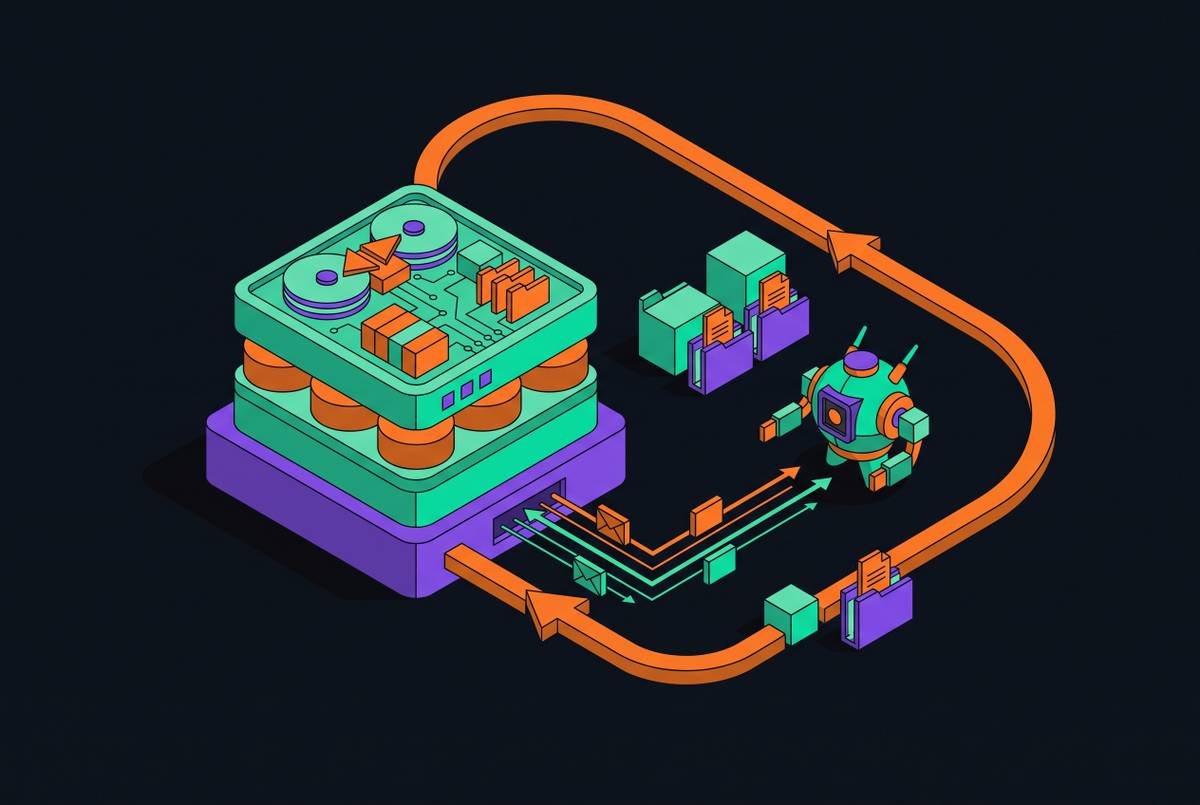
Every restart raises the same question: what does the agent actually need to read to pick back up? An agent that answers this by replaying its full raw conversation history every time it wakes will eventually produce degraded output at an unsustainable token cost, because the context window is a budget to be spent deliberately, not a scroll to be replayed in full. The pattern that solves this is an in-context working buffer paired with compression: the agent writes its immediate reasoning steps to a scratchpad, and as that buffer approaches a token limit, a summarization step compresses older turns into a dense background summary that keeps the logical conclusions and drops the raw tool outputs that produced them. When a task finishes, or the agent goes to sleep, whatever is worth keeping gets extracted into long-term storage and the rest is discarded, so re-entry reads the summary and the externalized checkpoint. This naturally separates into three layers, each with its own retention policy: short-term memory in the token window, a working buffer with compression, and long-term storage in the external store. Treating these as one undifferentiated pile of context is the mistake that drives token costs up over time.
Episodic memory: giving agents a usable record of what they have done before
The patterns so far solve resumability within a single extended task. Episodic memory extends that same logic across sessions, turning an agent that merely survives interruption into one that carries forward what it learned from doing the work. Episodic memory stores what happened, when it happened, and under what conditions, capturing events rather than general facts, with enough context to distinguish a specific failed attempt on a specific kind of task from generic background knowledge. A usable episodic record lets an agent re-enter a multi-day task on day three already knowing which subtasks are done, which approaches failed, and why, instead of reconstructing that picture by reading through raw logs. How the store is designed matters as much as what goes into it: an episodic store that has to scan every past event to find one relevant record does not scale, so retrieval needs to filter by task type, recency, or relevance to the current goal. At this point the four patterns covered so far stop looking like separate techniques and start looking like one system: checkpoints are what episodic memory stores, state externalization is what makes storing them possible at all, and the context buffer is the mechanism that pulls the right episodic records back into the working window instead of flooding it with everything the agent has ever done.
Infrastructure requirements for durable patterns under real load
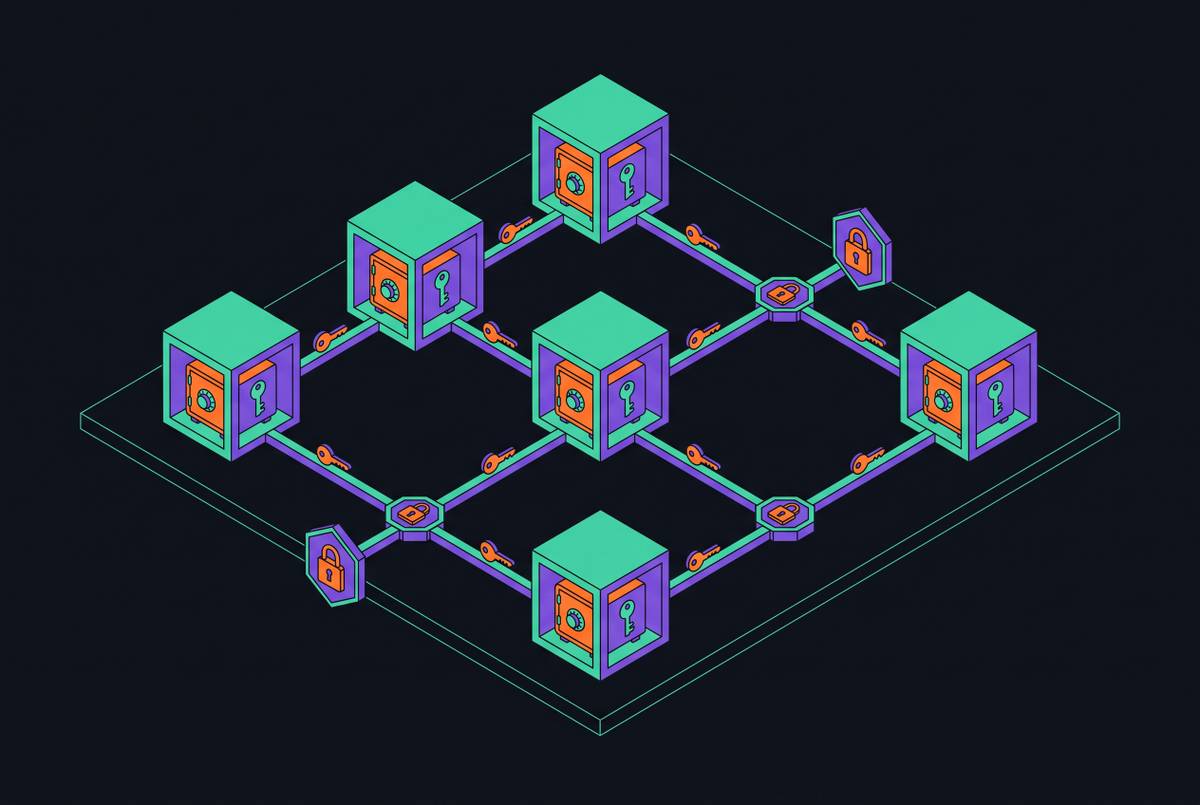
None of these patterns matters if the infrastructure underneath cannot support them at the speed and scale production traffic demands. An architecture built around state persistence and fast resume gets undermined by a hosting environment that cannot snapshot and restore an agent's full execution context quickly. Fast wake is a hard requirement rather than a convenience: an agent that takes several seconds to resume from sleep is not responsive enough for real user interactions, so the infrastructure has to restore a sleeping agent's full state and put it back into execution fast. Isolation matters just as much for any agent that installs packages, runs a browser session, or executes code it generated itself. Running agent-generated code requires a VM-level boundary rather than a shared-kernel container, because that code is untrusted at runtime, and a shared-kernel container exposes the host to kernel-escape exploits in a way a microVM does not. A microVM gives each agent its own guest kernel behind a hardware virtualization boundary. Micro-VMs backed by hardware virtualization, Firecracker is one example, provide exactly this: each agent runs its own kernel, so it can install software, run arbitrary code, and fail without putting other agents or the host at risk. Persistent disk is what makes state externalization real at the infrastructure level: an agent's files, credentials, installed packages, and working state have to survive sleep, and a container or serverless function that disappears between calls cannot hold any of it. The economics follow from the same constraint: most agents sit idle most of the time, and an infrastructure model that bills for compute during that idle time makes deploying one agent per user uneconomical at any scale. Snapshot-and-restore scheduling changes that math by letting an idle agent pay for storage instead of running compute, which is the cost structure that makes the per-user agent model work. A platform built specifically for persistent agent deployment, offering isolated micro-VM environments, persistent disk, snapshot-restore scheduling, and sub-second wake times as core primitives, earns its place in the stack by taking on the operational cost of building these requirements from scratch.
The workflow that survives: how the four patterns compose into one system
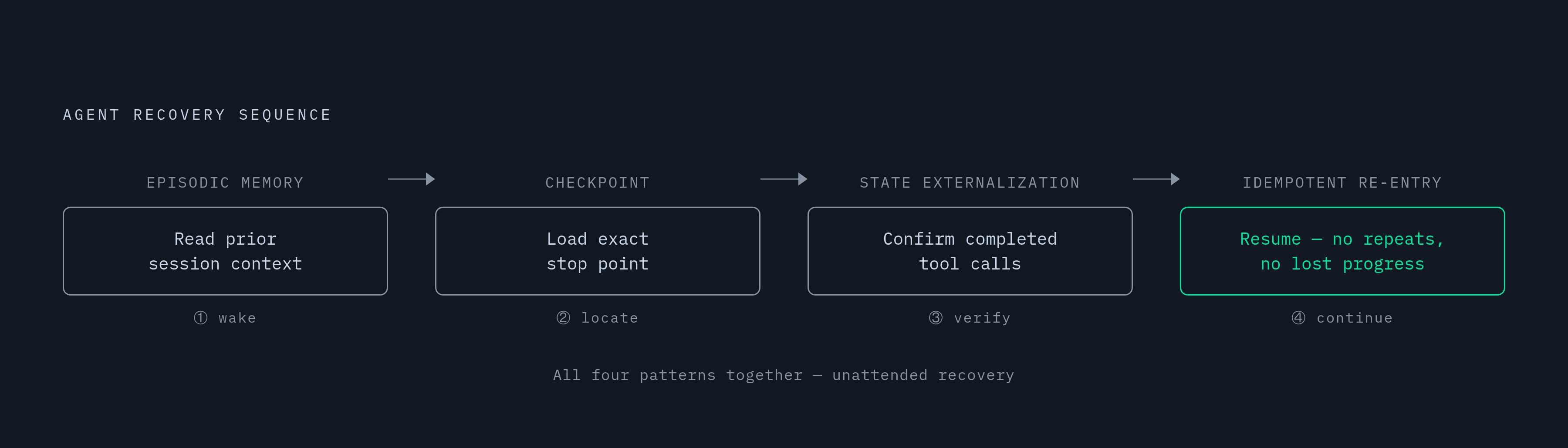
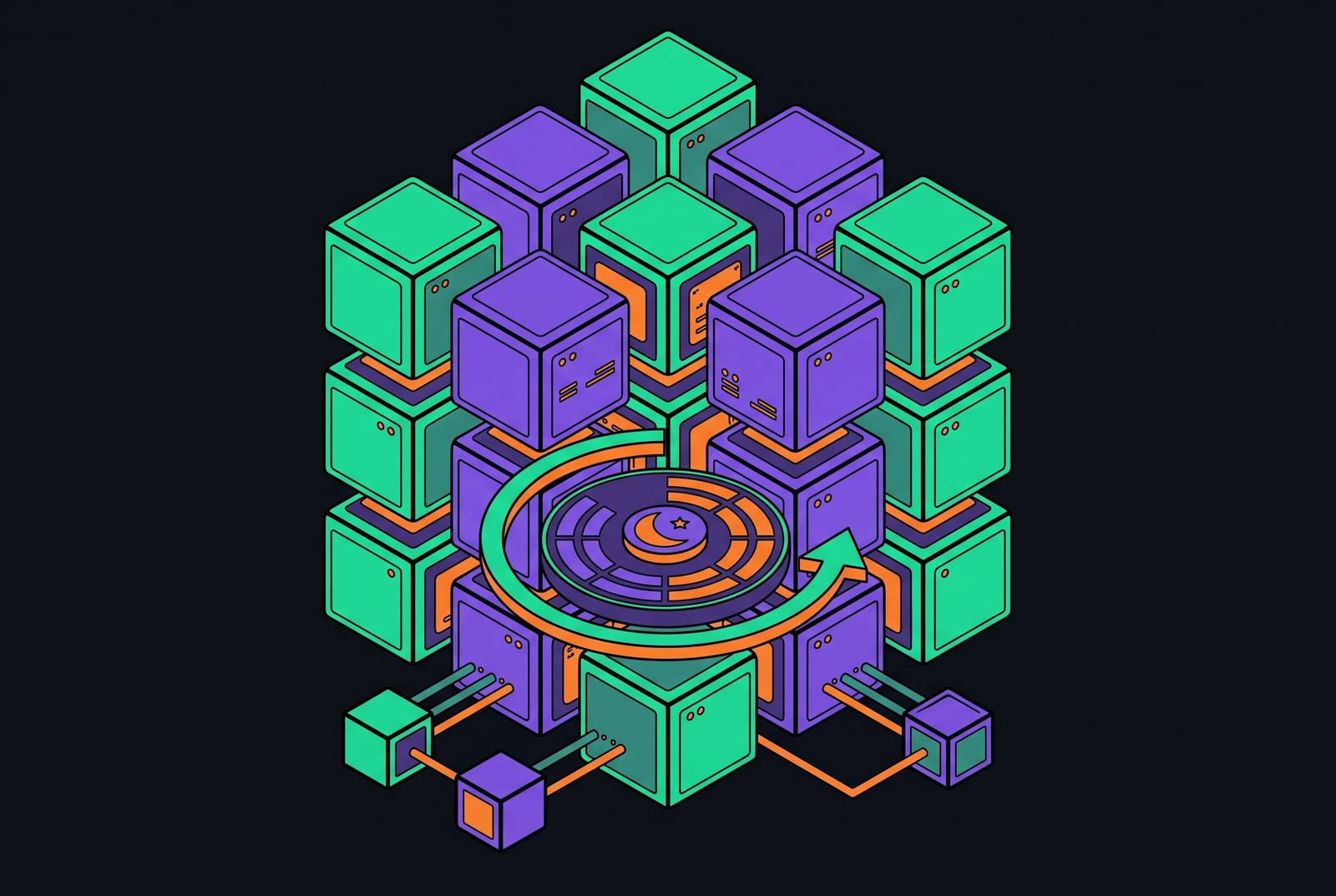
State externalization, checkpoint design, idempotent tool calls, and episodic memory are not four separate techniques to pick and choose from. Together they form one execution model in which an interruption at any point leaves the workflow in a state it can recover from cleanly. Consider a concrete sequence: an agent working through a multi-step task goes to sleep mid-execution; on waking, it reads its episodic memory for context from prior sessions, loads its checkpoint to find exactly where it stopped, checks its externalized state to confirm which tool calls already completed, and resumes from that precise step, with no repeated actions, no lost progress, and no need to reconstruct context from scratch. Each pattern plays a distinct role in that sequence. Episodic memory supplies the long-horizon context. Checkpoints mark the agent's position at the level of individual steps. State externalization is the mechanism that makes both of those durable across a restart, and idempotency is what makes re-entry safe no matter which exact moment the interruption happened to land on. None of this depends on a smarter model, a larger context window, or a human watching the process around the clock. The reliability comes from how the system is designed to handle interruption, not from how capable the model underneath it happens to be.