Agent Memory Architecture Beyond Vector Databases
Vector databases alone can't handle long-running agents, concurrent writes, or changing facts.
Vector databases became the default memory layer for AI agents because they solve similarity search: finding what's similar to a query. That reasoning holds up in a demo and breaks down once agents run long, run concurrently, or run against facts that change. This piece traces where that logic fails and what a full memory architecture looks like once you move past similarity search as the whole answer.
How vector databases became the default agent memory choice
A team building an agent needs it to recall things. The fastest way to get there is to embed every piece of text the agent has seen and search by cosine similarity when a new query comes in. It works immediately, it requires no schema design, and it plugs directly into retrieval-augmented generation, so the choice feels less like a decision and more like the obvious next step. The trouble is architectural: a vector database answers "what is similar to this?" while an agent actually needs an answer to "what do I know, and is it still true?". Those are different questions, and conflating them is where most production memory systems start to come apart.
Three failure modes appear once an agent leaves the demo environment. Retrieval latency grows with the corpus: deeper traversal and larger candidate sets add time on top of an already meaningful baseline, before the embedding model and reranking step even run. Appending every interaction without ever removing or merging anything produces retrieval noise and context dilution, because nothing in a vector store forces deduplication or consolidation. And when two agents touch the same fact at once, similarity search offers nothing resembling a lock or a transaction, so the gap between what each agent believes grows with every concurrent write.
None of this appears in a single-session chatbot demo. It appears in long-running agents, in pipelines where multiple agents share state, and in domains where the underlying facts change week to week. The ceiling on vector-only memory becomes visible once an agent runs long enough, or with enough other agents, to hit it.
Three memory types production agents need, and the storage primitive each requires
Production agents need three distinct kinds of memory, and a vector database does a good job with exactly one of them. The mismatch between memory type and the storage system meant to hold it is the root cause behind most of the failures described above, and fixing it starts with naming the three layers.
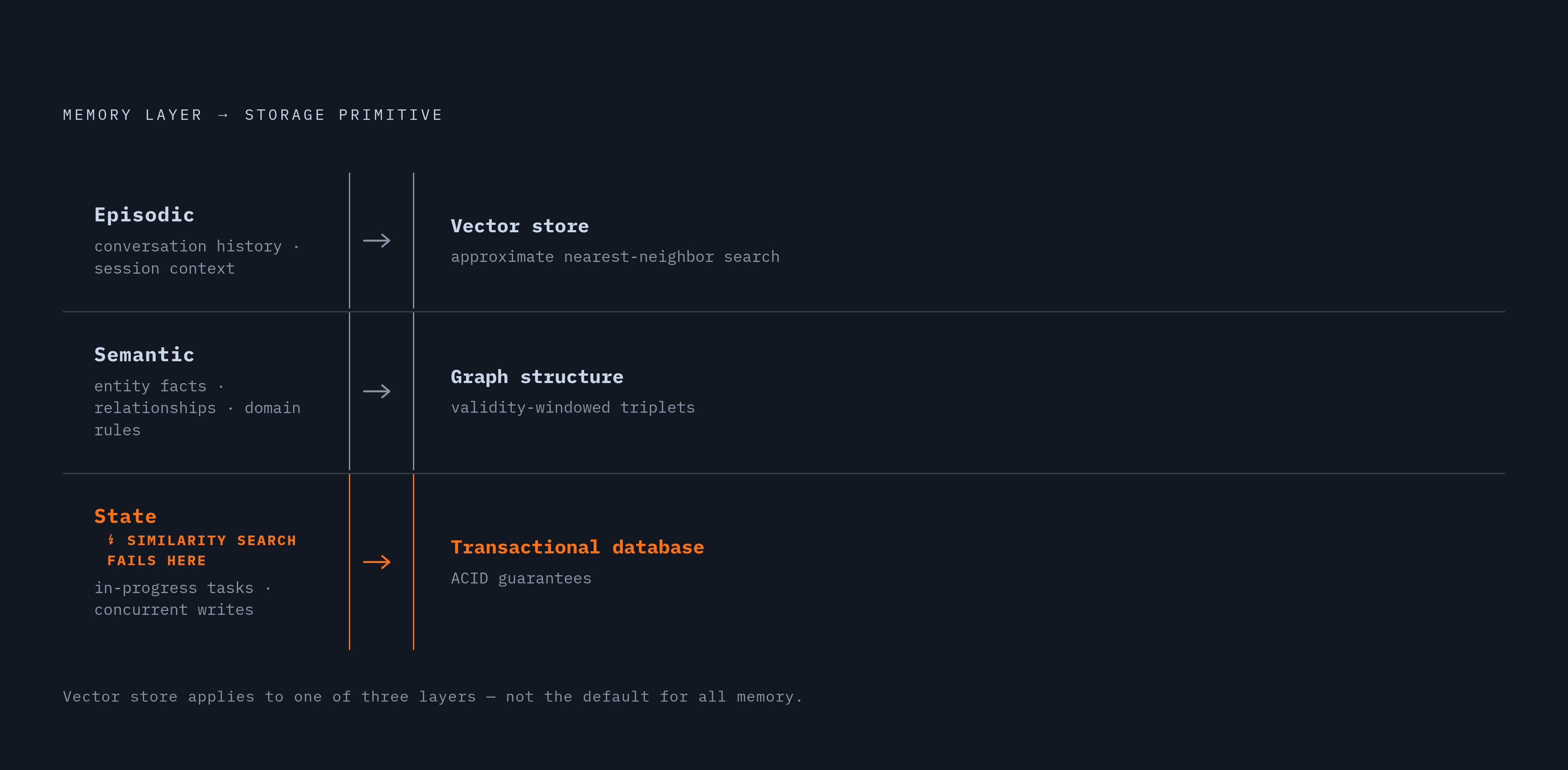
Episodic memory covers conversation history, recent session context, and the kind of surface personalization that makes an agent feel like it remembers recent interactions. This is where vector search earns its reputation: fast approximate nearest-neighbor lookups over session logs are a good fit for this layer, and nothing about it demands more.
Semantic memory is the accumulated set of facts an agent holds about entities, relationships, and the rules of whatever domain it operates in. This layer needs graph structure, because a flat list of embeddings can't resolve a multi-hop chain like "Alice was budget owner until February, then it moved to Bob, and Bob reports to Carol," the kind of procurement-workflow case Vectorize's 2026 memory framework comparison uses to illustrate exactly this gap. A vector store can tell you that a passage about Alice and a passage about Bob are both relevant to a query about budget ownership. It can't tell you which one is current.
State memory is working memory for a task in progress, the kind of thing an agent needs when it's partway through a multi-step job and other agents or processes might touch the same data before it finishes. This layer needs transactional guarantees, and similarity search is the wrong mechanism for it outright, because concurrent writes from multiple agents need ACID semantics, not proximity in embedding space. The PVLDB 2026 unified memory framework paper classifies twelve representative memory methods across four dimensions, information extraction, management operations, storage structure, and retrieval mechanism, and its conclusion lines up with the practical failures above: no single storage structure serves all three layers. Composing the right primitives means routing each type of memory to the one built for it.
How semantic memory breaks when facts change over time
The sharpest version of the semantic memory problem is staleness. An append-only vector store has no way to flag a fact as outdated, so two embeddings stored months apart read as equally "similar" to a query if their wording matches, regardless of whether the second one supersedes the first. Nothing in the architecture tracks which fact is current. The system just returns both and leaves the contradiction for whoever (or whatever) reads the output.
Graphiti, the engine behind Zep, takes a different approach: it models facts as triplets carrying validity windows, recording the point at which a fact became true and the point at which it stopped being true. That's a real departure from the append-only model, not an incremental tweak to it, because it gives the system a built-in notion of supersession: a new fact about budget ownership doesn't just get added next to the old one, it replaces it in a way the system can track and query.
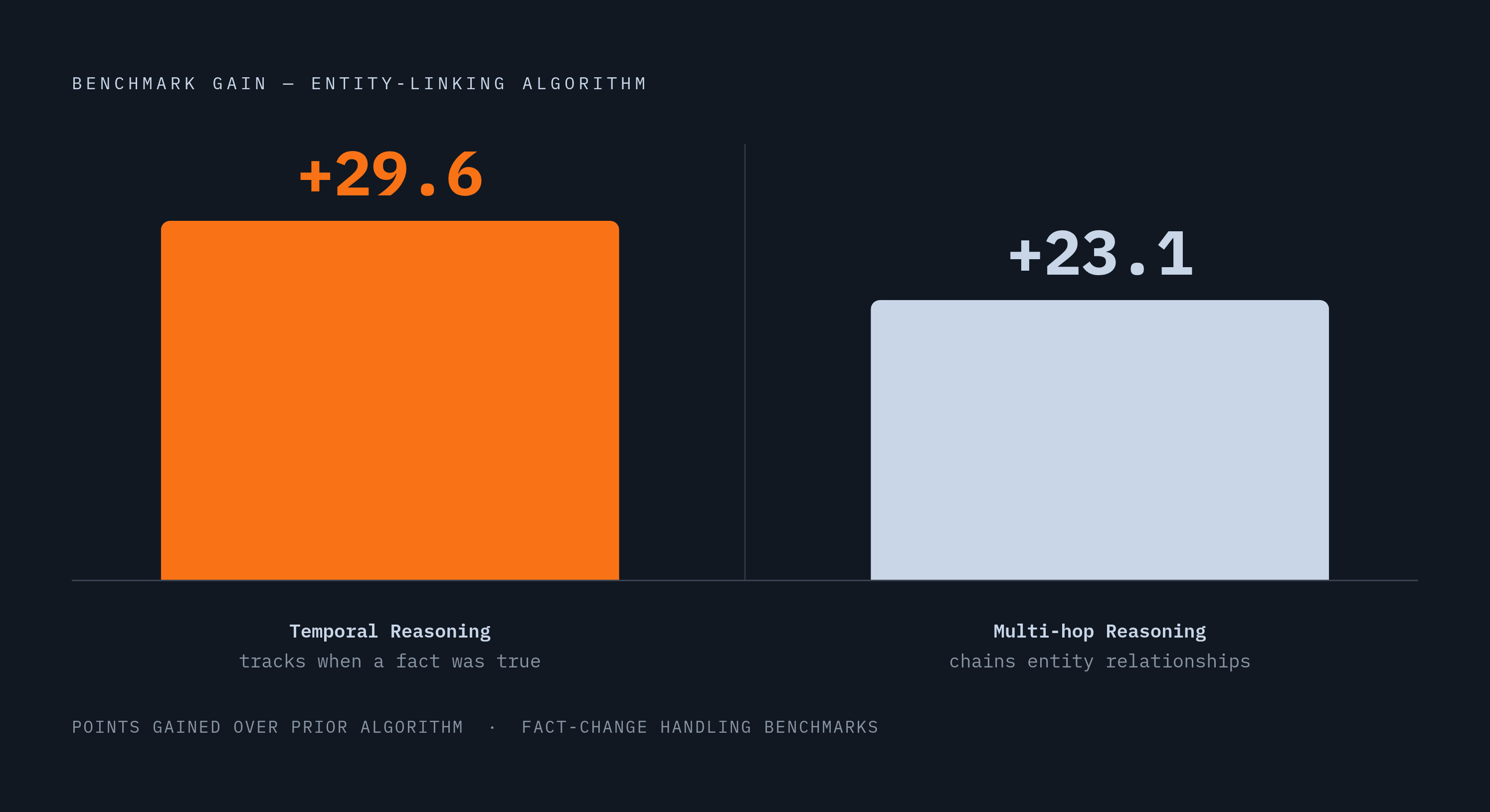
This doesn't fully close the gap. Mem0's State of AI Agent Memory 2026 report names cross-session identity, temporal abstraction at scale, and memory staleness as the hardest unsolved problems in the field, and those are precisely the three problems temporal modeling addresses without fully solving. Mem0's own response has been to move entity linking into the core system: its newer open-source algorithm extracts entities from each memory during the add() operation and stores them in a parallel entity collection, so temporal and relational structure gets maintained without standing up a separate graph database. The results on Mem0's benchmarks make the mechanism's value concrete rather than abstract: the largest gains over the prior algorithm are +29.6 points on temporal reasoning and +23.1 points on multi-hop reasoning, the two categories that most directly test whether a system can handle a user's history as facts in it change. Those numbers confirm that tracking when something was true changes what an agent can reliably answer.
State memory requires transactional guarantees that no retrieval system provides
In-progress task state is the layer where similarity search doesn't just underperform, it's the wrong category of tool. When agents execute multi-step workflows at the same time, correctness has to be transactional. A system either commits a write or it doesn't; there's no equivalent to "probably correct" the way there's a notion of "probably relevant" in search.
The failure case is concrete. If one agent updates a shared record, a customer's risk profile, a budget's approval state, while a second agent is mid-decision based on a read that happened before the update, the second agent needs to know its data is now stale, or the write needs to be atomic and immediately visible. Nearest-neighbor search has no mechanism for either. The production answer to this is the checkpoint-and-resume pattern: a durable checkpoint store keyed to a stable run identifier, a checkpoint writer that snapshots agent state at every step boundary, a ledger for pending writes from parallel batches that partially failed, and a wrapper around non-deterministic operations so that resuming an agent replays from checkpoint instead of re-running side effects a second time.
The storage options for this layer split along latency lines. Redis gives ultra-low-latency in-memory storage, which makes it a strong fit for session context and transient agent state, according to PingCAP's agent database guide. Distributed SQL databases, which bring horizontal scalability, strong ACID guarantees, and tenant isolation, handle concurrent state updates and growing memory footprints more predictably than a single-node system does, per the same guide. Neither is being recommended here as the single right answer. Each is suited to a different point on the latency-versus-durability tradeoff, and the choice depends on how long the state needs to live and how many agents touch it at once.
A large share of what looks like a model failure actually originates elsewhere in the system, and gains measured at the model layer often don't show up in end-to-end task outcomes when the state layer underneath is unreliable, as the Engineering Reliable Coding Agents monograph (arXiv 2026) argues. A better model can't compensate for a state layer that loses writes or replays side effects twice.
Retrieval requirements across memory types and scopes
Once memory is split across episodic, semantic, and state layers, retrieval has to do more than rank by cosine similarity. It has to know which layer a query is really asking about and filter by scope before it ever scores relevance.
Mem0's retrieval stack is a working example of what that looks like in practice: it runs three scoring passes in parallel, semantic similarity, keyword matching, and entity matching, then fuses the results, and the combined score beats any one signal on its own. Scope and actor metadata carry as much weight as the scoring method itself. In a multi-agent system, messages from a user stored under a user_id and messages generated by an agent stored under an agent_id can be filtered separately at query time, which keeps a fact the user actually stated distinct from one the agent inferred. Metadata filtering by context tags, something like "healthcare" or "Q4-budget", lets a query target a structured attribute independent of the words in it, a capability that got substantially more useful with Mem0's v1.0.0 release; before that version, memory search was purely semantic.
Token cost at retrieval time is a production constraint on its own, not a secondary performance metric. A system that scores well on accuracy but burns far more tokens per query doesn't survive contact with the throughput real agent workloads demand, which is what the BEAM benchmark, built and tested at large token scales, was designed to expose. Three benchmarks now define how the field measures retrieval quality: LoCoMo, LongMemEval, and BEAM, covering multi-session recall, temporal reasoning, and large-scale scenarios respectively, and together they stop teams from optimizing accuracy while ignoring token consumption or latency. Their existence shows that memory retrieval is now mature enough to need rigorous, standardized measurement, not just a leaderboard for bragging rights.
Consolidation and forgetting become necessary operations as memory accumulates at scale
An agent that only ever appends to memory degrades on a predictable schedule. Retrieval noise climbs, context dilutes, and latency creeps upward, and none of that is a retrieval algorithm problem. It's a lifecycle management problem: nothing in the system ever decides that a memory is redundant, outdated, or no longer worth keeping active.
Consolidation is the operation that prevents this: deduplicating memories, scoring them for ongoing relevance, and discarding what no longer earns its place, so the active store stays dense with useful signal instead of bloated with repeats. Vectorize's 2026 comparison draws a useful line here between two kinds of memory that need different handling. Personalization memory, user preferences and conversation history, can decay naturally, since older preferences simply matter less than recent ones and nothing is lost by letting them fade. Institutional knowledge memory, the extracted lessons, domain patterns, entity relationships, and corrections that accumulate over time, needs active curation instead, because an old correction is often still exactly as valuable as a new one. A procurement agent that gets corrected on a vendor policy once and then forgets that correction a month later, because nothing marked it as durable, relearns the same mistake every session. That's the concrete cost of treating institutional knowledge like it decays the way a user's coffee preference does.
Forgetting safely means knowing what can be dropped without hurting future performance, and that decision needs a basis. Memories need provenance: where a fact came from, when it was formed, how many times it's been retrieved and acted on. Without that record, a discard decision is a guess. Mem0's architecture treats agent-generated facts as first-class alongside user-stated ones, so the system always knows whether a given memory was asserted by a user or inferred by the agent itself, and that distinction shapes how confidently it can be retired later.
Mapping storage primitives to memory types
The right storage choice depends entirely on which memory type it's serving. No single database spans all three layers well, so the real question is which primitives to combine, not which one to pick instead of the others.
For episodic memory and semantic search, purpose-built vector stores do the job well. Pinecone, cited by PingCAP's 2026 guide as the managed option for high-performance similarity search, handles this layer effectively but still needs a separate system next to it for structured agent state. Open-source options, Qdrant and Weaviate among them per the same guide, offer strong vector search with metadata filtering and hybrid retrieval and suit semantic memory well, though they generally need to be paired with a relational database to cover episodic and procedural layers.
For short-term state and session context, Redis gives ultra-low-latency in-memory storage for transient agent state, and its RediSearch module adds vector similarity search and semantic caching on top; it isn't built to serve as a long-term system of record, so it fits this narrow role rather than the full memory stack.
For multi-agent state with concurrent writes, distributed SQL databases bring horizontal scalability, strong ACID guarantees, and tenant isolation, which matters directly for multi-agent systems managing concurrent state updates against a growing memory footprint.
For temporal and relational semantic memory, the Zep/Graphiti pattern of validity-windowed triplets is the production approach for facts that change over time, and it replaces what used to require a standalone graph database with entity linking built into the memory system itself.
For teams that want one system spanning all these layers, unified databases combining distributed SQL, vector search, HTAP, and ACID transactions, TiDB is the example PingCAP's 2026 guide points to, cut down on operational overhead at the cost of some tuning depth in any single layer. A unified system is easier to run day to day and harder to push to the limit in any one dimension compared with a specialized tool built for just that dimension.
Persistent, isolated agent infrastructure is the physical prerequisite for durable memory
Every architectural choice above assumes the agent process itself has somewhere stable to run. A stateless serverless function that tears down after each invocation can't hold a checkpoint store, can't maintain a persistent entity graph, and can't keep session-scoped metadata alive between calls, because the agent's state has nowhere to live once the function exits. The memory architecture only works if the compute layer underneath it persists.
What this requires is straightforward to state even if it's easy to overlook: the agent needs a long-lived, isolated execution environment with its own persistent disk, not a function that spins up fresh for every request. Checkpoints need a stable run identifier to write against. Entity graphs need a process that stays up long enough for their validity windows to mean anything. Session metadata needs a place to sit between one call and the next. None of the storage decisions traced through this piece, vector stores for episodic recall, temporal graphs for semantic memory, transactional databases for state, mean anything if the infrastructure running the agent resets to zero every time it finishes a task. Durable compute is what durable memory depends on.
Sources
- Agentic AI Memory vs Vector Database: Architecture Guide 2026
- State of AI Agent Memory 2026: Benchmarks & Trends
- Best Database for AI Agents (2026): Memory, State & RAG Guide
- Memory in the LLM Era: Modular Architectures and Strategies in a Unified Framework
- Best AI Agent Memory Systems in 2026: 8 Frameworks Compared
- Engineering Reliable Coding Agents: Evaluating and Operating the System Around the Model