When Lambda Timeout Errors Are Telling You to Rethink Your Execution Model
Timeout errors on Lambda agents signal you need persistent infrastructure, not just a higher limit.
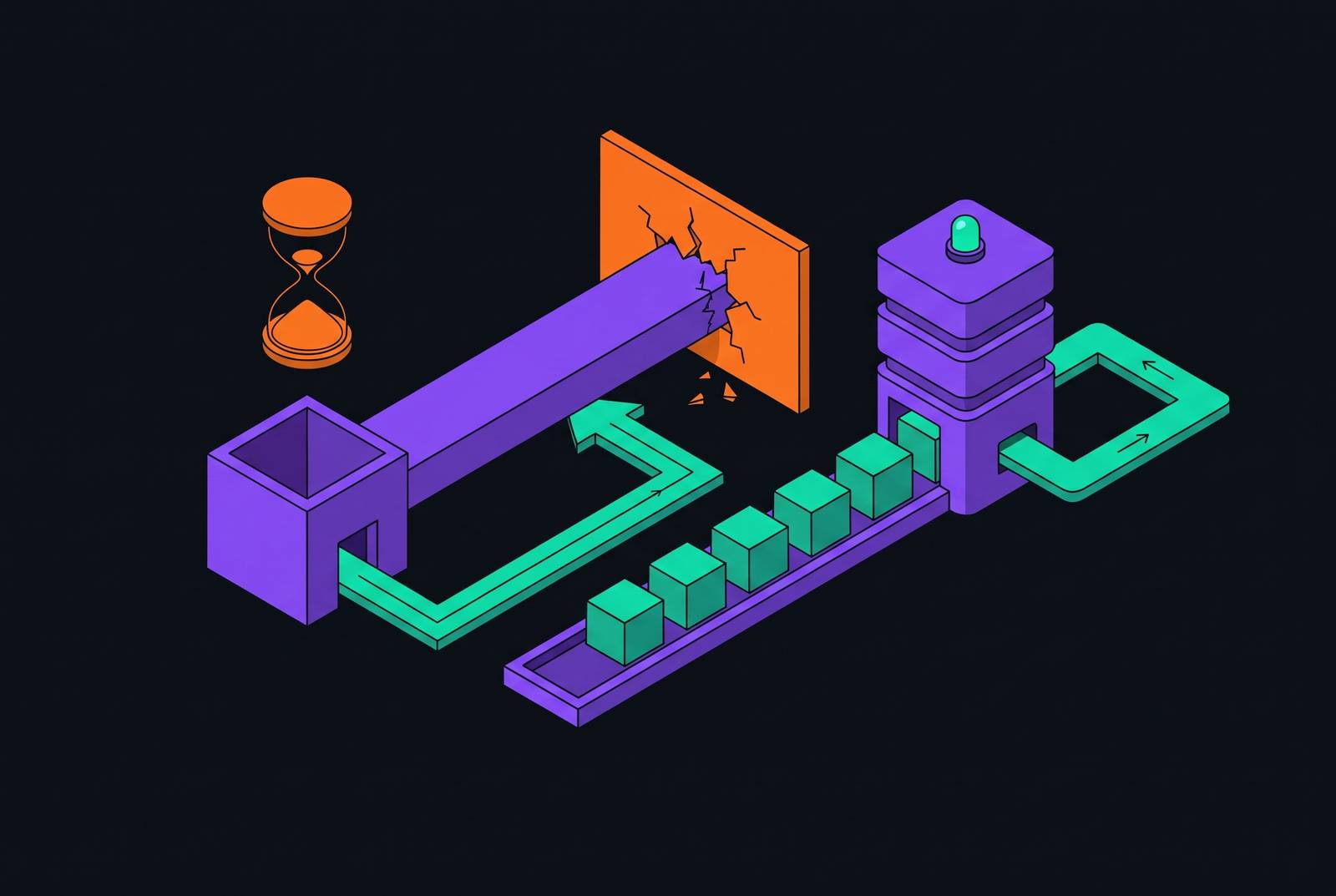
Lambda timeout errors on agent workloads often signal an execution-model mismatch. Serverless functions suit bounded, stateless tasks, while persistent AI agent infrastructure supports state, continuity, and open-ended work. When an agent must survive human pauses, retain its working environment, or choose its next step dynamically, raising the timeout postpones the failure without supplying the missing architecture.
What Lambda timeout errors actually are on agent workloads
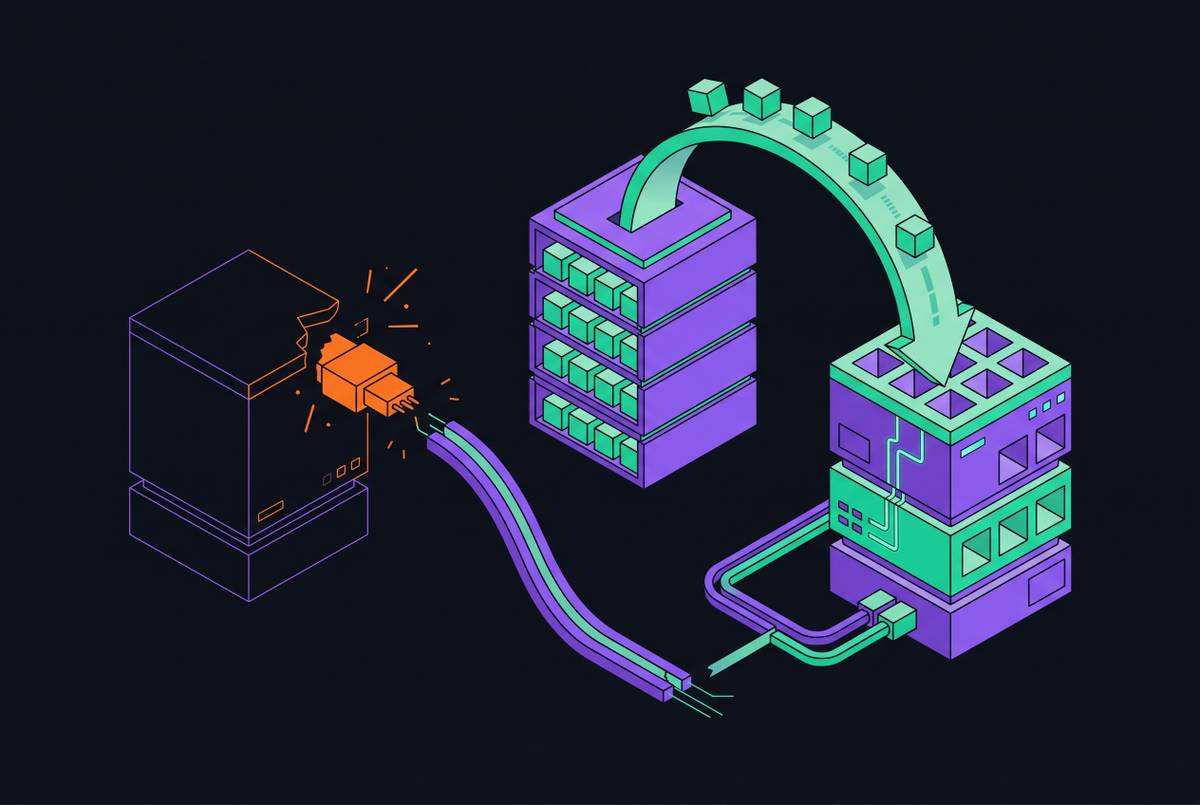
The timeout fires, the agent dies mid-task, and state that was not persisted externally is lost. The immediate failure is an interrupted invocation. The deeper failure is a mismatch between the lifetime of that invocation and the lifetime of the agent’s work. An iterative reasoning loop, a long-context model call, a human approval gate, and chained tool use do not necessarily fit within a predetermined execution window.
Lambda is built around a different premise. AWS’s Lambda quotas documentation describes it as “designed for short-lived compute tasks that do not retain or rely upon state between invocations”. That design works for request-response inference, event-driven processing of one item at a time, and light API orchestration. Each invocation can finish without depending on a continuing execution environment. An agent whose next action depends on what it just learned has no equivalent guarantee, so the timeout exposes an assumption about the task that a larger timeout setting leaves unchanged.
Why the instinct to tune around the timeout misreads the error
Raising the limit is the most direct response. Other responses include splitting jobs, checkpointing to DynamoDB or S3, and chaining functions through Step Functions. Those approaches can make bounded, predictable batch jobs work well, because their boundaries are known before execution begins. Open-ended agents lack that convenient structure.
Checkpoint-and-resume also creates a contract the developer must maintain. The application has to define resumable state, serialize it correctly, and restore it without losing the context needed for the next action. Rich context windows, tool histories, and in-progress file writes add to what serialization must cover. Retries and idempotency add further work around the invocation boundary.
Serverless simplicity can justify this work for some tasks. But the complexity budget grows with the agent’s autonomy, because more of its behavior must fit an externally defined recovery scheme. AWS has responded to pressure for longer execution, but that response requires a precise reading of which limits changed.
What AWS’s September 2026 timeout extension actually changes — and what it does not
AWS extended the maximum function timeout to 90 minutes on September 9, 2026. The scope is narrower than the headline suggests. The extension applies to Lambda Managed Instances functions invoked asynchronously or through an event source mapping, except Amazon MQ and Amazon DocumentDB mappings. Synchronous invocations, including API Gateway requests and direct SDK calls, do not receive that maximum.
Managed Instances runs functions on EC2 instances in the customer’s VPC, supports multiple concurrent requests per instance, and uses EC2-based pricing. Standard event-driven functions still have the 15-minute limit that Lambda has had since 2018. The extension helps with bounded work such as media transcoding, financial calculations, and ETL, but the need for persistent state and what continuity means stay the same.
AWS also distinguishes event handling from longer-running code execution. Its Compute Blog describes HTTP-driven MicroVMs for user- or AI-generated just-in-time code with an 8-hour duration. Lambda durable functions take another approach, using checkpoints and replay to recover progress, with asynchronous multi-step executions lasting up to one year. Even with these options, a longer timeout alone cannot keep an agent’s memory, files, and live working environment intact across a pause.
What do agents actually need from their execution environment?
A long-horizon agent may spend hours pursuing one objective, while a persistent agent retains files, credentials, browser sessions, and working memory across sleep boundaries. Its next session begins with the consequences of the previous one intact. Continuous identity and resumable execution are therefore architectural requirements.
Production agent patterns reflect those requirements. Checkpoint-and-resume supports failure recovery, while delegated approval lets a human decision interrupt progress without discarding execution state. Memory-layered context needs identity controls, ambient processing supports event-driven autonomous work, and fleet orchestration coordinates specialist agents over long horizons. Each pattern presupposes a durable substrate, though the state it preserves differs.
Graph-based workflow frameworks make one form of durability explicit. After each step, they persist variables, history, and workflow position so a failed agent can reload its last checkpoint. That store must remain accessible and economical across arbitrarily long gaps. Human approval also means an agent must wait without using compute or expiring before the response arrives. The execution environment must separate the lifetime of the agent’s state from the time it spends actively computing.
Why Firecracker micro-VMs have become the infrastructure baseline for persistent agent execution
Firecracker micro-VMs provide an isolation boundary suited to that separation. Each agent can have its own kernel, disk, and network namespace, with room to install packages, run browser sessions, and maintain its working environment without touching another agent’s environment. Fast boot and lean memory use make per-agent isolation practical at fleet scale.
AWS Bedrock AgentCore uses this boundary for agent tools. It provisions a dedicated Firecracker micro-VM per agent session for its Code Interpreter and Browser tools. Micro-VM isolation supplies both a security boundary and control over the guest environment.
An agent can change dependencies, write to its disk, and break and rebuild its own environment. Lambda instead provides a filesystem that is read-only except for /tmp, within execution environments that may be reused across sequential invocations of the same function. Those environments are isolated, but reuse is not a persistence contract. Managed tooling is taking on more of the work of running micro-VMs, while snapshot-restore cuts the cost of keeping their state available.
How snapshot-restore makes per-agent micro-VM fleets economically viable
An isolated environment need not remain a running environment. Agents spend most of their time idle, so the economic case rests on paying for storage during those periods and releasing reserved compute. Snapshot-restore checkpoints a running micro-VM’s full memory and device state to disk when the agent goes idle. The process then terminates, reducing its compute use to zero.
When work returns, the snapshot restores the execution state. Execution can resume in milliseconds without the agent having to reconstruct its working context as a new invocation. This fits the stop-start pattern of agents waiting for events or human input.
Memory sharing further changes the fleet calculation. Hundreds of sandboxes restored from a common base image can read the same underlying physical RAM pages until they modify them. Additional physical memory is needed for the pages each agent writes, rather than for a full independent copy of every environment. Snapshot storage still has a cost, however, and placement becomes an engineering concern. Snapshots used often belong on fast local disk, while those used rarely can move to cheaper object storage.
What the idle-cost problem reveals about infrastructure model selection
Infrastructure and orchestration are major economic levers in agent deployments. Model inference accounts for a minority of total cost, while infrastructure, orchestration, tooling, and governance consume the majority. Changing the orchestration layer while keeping the same model can shift per-task cost more than moving between the cheapest and most expensive model tiers.
Agents are idle for the large majority of their active session time, and memory sits idle for more than half of runtime. Paying for live compute during those gaps makes the wait costly. Human-in-the-loop suspension is a particularly direct opportunity, because snapshotting and terminating the agent removes idle-pending compute while retaining the state needed after approval.
Orchestration costs grow nonlinearly, and a small fraction of tenants can drive a disproportionate share of token spend and infrastructure cost. To see margins, costs must therefore be assigned to each tenant by attaching tenant identity to every span, collecting usage from provider responses, and feeding it into metered billing. The execution model sets how resources are used, while attribution shows which tenants use them. Both become central when an agent product moves from isolated tasks to a multi-tenant fleet.
The per-user agent model and where isolation actually needs to happen
Each user’s agent runs in an isolated environment with its own persistent state, so each boundary needs a defined place in the architecture. A secure database arrangement does not, by itself, contain arbitrary code running in an agent sandbox.
At the data layer, pooled schemas with row-level security cost the least but still carry noisy-neighbor risk. A silo database for each tenant gives the strongest data isolation and costs the most across the fleet. A pooled core with silo islands for sensitive data or workloads balances those tradeoffs.
At the sandbox layer, the threat model sets a stricter requirement. For this threat class, user-supplied code, AI-generated code, and arbitrary tool calls need the hardware virtualization that micro-VMs provide beyond what containers or shared runtimes offer. The memory-sharing mechanism described earlier helps reconcile that boundary with fleet economics, because writable-memory demand follows divergence from the base image. An LLM gateway provides the mandatory control point for per-tenant rate limits, cost attribution, and governance that the agent layer cannot enforce by itself.
Reading the timeout error correctly — what it tells you about your next architecture decision
The choice starts with how long the task lasts and what state it needs. Lambda remains appropriate for bounded request-response inference, individual-item event processing, and light API orchestration where each invocation is stateless and self-contained. The Managed Instances extension expands the range of bounded long-running work, while durable functions support checkpointed multi-step execution. A timeout on such work can still be a configuration or decomposition problem.
The lesson changes when continuity is part of the task. An agent that must survive an open-ended approval pause, accumulate files and browser state across sessions, or choose an unpredictable sequence of actions needs more than additional invocation time. A large per-user fleet adds another criterion, because paying for idle compute compounds across agents. In those conditions, the next architecture decision should move from adjusting the timer to choosing how to provide persistent execution.
Tooling increasingly exposes that choice directly. The open-source Stallo project provides snapshot lifecycle operations through MCP tools and a CLI, with its guest agent reconnecting within 10 seconds of restore. PandaStack treats snapshot-restore as its primary boot path and is self-hostable on KVM hosts. By contrast, the AWS Agent Toolkit can configure the 90-minute timeout through natural language prompts in AI coding assistants. These tools make different operations easier, but they do not make the underlying execution models equivalent.
The choice depends on what must survive when computation stops. If the answer is only a completed result or a defined workflow checkpoint, a bounded invocation may be sufficient. If it is the agent’s continuing working environment, the timeout is evidence that the task has outgrown the invocation model.