Browser Session Persistence in Headless Agent Workflows
Authenticated browser contexts must persist across agent restarts and reasoning cycles.

Browser session persistence is the architectural problem that every headless agent workflow eventually runs into, and the reason is structural: the browser was never built to hold state across restarts. The web browser was built for stateless, one-shot HTTP requests: a page loads, a form submits, a response comes back, and the transaction ends. Autonomous agents need something the browser was never designed to give them: authenticated, multi-step sessions that stay intact across LLM reasoning cycles, tool calls, rate-limit pauses, and restarts that can happen minutes or days apart.
Without persistence, the failure is immediate and it compounds. Every time the agent restarts, it lands back on a login page. OAuth flows and SAML assertions have to run again from the beginning, token by token, redirect by redirect. Many sites fingerprint headless browsers before they ever serve real content, throwing a CAPTCHA in front of the agent the moment it tries to move past the front door. None of this is a rare edge case; it only shows up under unusual conditions for someone who hasn't hit scale yet. It's the default behavior of headless Playwright: start it up and it hands you a fresh, anonymous browser with no saved sessions, no cookies, and no authentication of any kind.
A single agent hitting this wall once is a nuisance that costs a developer a few minutes of debugging. Running hundreds of concurrent agent sessions against the same problem produces a reliability failure that no amount of retry logic or prompt engineering fixes, because the browser layer itself has no memory. Solving that gap at the application layer, one workaround at a time, doesn't scale. Solving it at the architecture layer does, and that's the argument the rest of this piece makes.
What browser state consists of
Treating "session state" as one blob of data is where a lot of persistence designs go wrong. Browser session state is a composite of several distinct kinds of data, each stored differently, and an agent needs all of them if it's going to resume a session without logging in again.
Cookies carry most of the authentication weight. Session tokens, remember-me tokens, CSRF tokens, and third-party single sign-on cookies all live here, and together they're what tells a server "this is the same identity that logged in before." Alongside cookies sit localStorage and sessionStorage, the client-side stores that modern single-page applications lean on heavily: JWTs, user preferences, feature flags, and other bits of application state that the server expects to find waiting on the next request. Indexed DB and cache storage round out the picture for more complex applications, progressive web apps and enterprise dashboards in particular, which use them to hold structured data and offline assets that affect how a page renders and how forms behave once loaded.
The practical unit that captures all of this at once is what Playwright calls a browser context, an abstraction that bundles cookies, storage, and permissions into one isolated session boundary. Serializing that context out to a file, commonly an auth.json, is the minimum viable version of session persistence. It's a small file, but it represents everything standing between an agent and a working, authenticated browser the next time it runs. Treat it with the same seriousness as a password, because that's functionally what it is.
The two-phase pattern: capturing state once, restoring it per run
The industry has mostly converged on a single pattern for handling this, and it works because it separates two jobs that are easy to blur together: capturing authenticated state once, and restoring that state on every run afterward. Each phase has its own constraints, and conflating them is where most fragile implementations come from.
The capture phase happens rarely, often just once, or on a rotation schedule when tokens expire. An agent, or a human operator supervising it, runs through the full login flow in a non-headless or otherwise supervised browser: username and password, multi-factor prompts, OAuth consent screens, CAPTCHA challenges, whatever the target site requires. Once that flow completes and the browser sits in an authenticated state, the full context gets serialized and written somewhere durable, whether that's a file on disk, an object in blob storage, or a secrets manager for anything especially sensitive. That artifact should be handled like a credential rather than a convenience file, because it grants the same access as the original login. It needs encryption at rest and it needs to be scoped tightly to the agent identity that will use it.
The restore phase runs on every single invocation. Before the agent touches any authenticated URL, it loads the serialized context into a fresh browser instance first. The step that's easy to skip, and shouldn't be, is verification: many session tokens expire on a timer or get invalidated by a server-side logout, so the agent needs to check that the restored session actually still works before proceeding. An agent that charges ahead with a dead session reaches authenticated content, fails somewhere downstream, and produces an error that's much harder to trace back to its real cause than a clean, early failure at the session check would have been.
Session state within a persistent agent's memory architecture
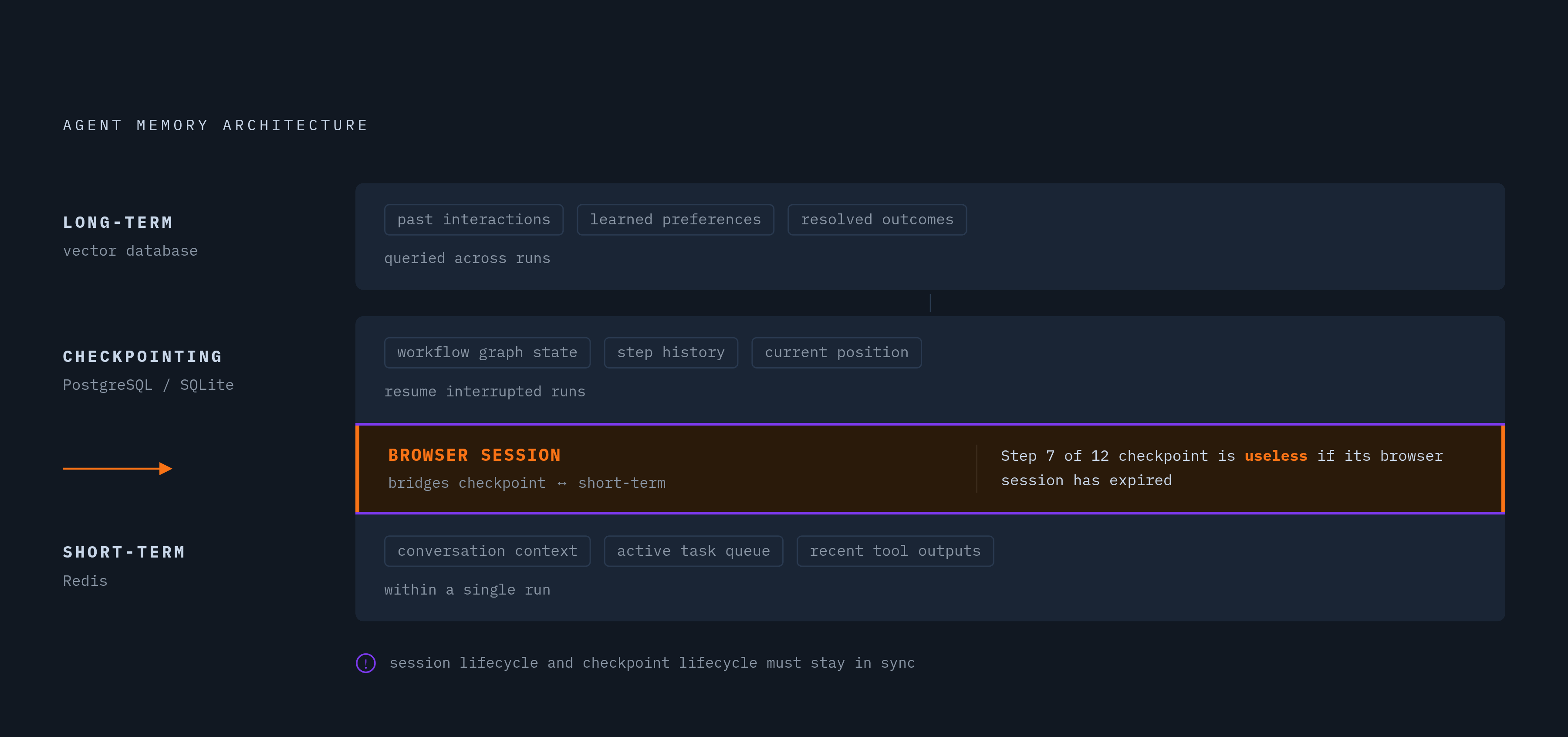
Browser session state is one layer in a larger memory architecture that any persistent agent needs, and treating it as an isolated concern, solved once and forgotten, tends to produce designs that are fragile at other layers even when the browser context itself is handled correctly.
Production agents generally maintain three tiers of memory, and each one has a different job and a different durability requirement:
| Tier | What it holds | Where it lives | Durability need | |---|---|---|---| | Short-term memory | Current conversation context, active task queue, recent tool outputs | High-churn, low-latency store (Redis or similar) | Needed within a run, not across a long sleep | | Long-term memory | Summarized past interactions, learned preferences, resolved outcomes | Vector database or structured store, retrieved by semantic search | Needed across runs, queried rather than loaded wholesale | | Execution checkpointing | Workflow graph state: variables, step history, current position | Durable relational store (PostgreSQL, SQLite) | Needed so an interrupted run resumes without redoing finished work |
Browser session state sits between execution checkpointing and short-term memory. It's durable enough to survive a long sleep or a redeploy, which puts it closer to a checkpoint than to a cache. But it's consumed fresh by the browser context on every run, which puts it closer to short-term state than to a permanent record.
That positioning creates a coupling, and it's easy to miss until it breaks something. Suppose the execution checkpoint records that an agent was on step 7 of a 12-step workflow. If the browser session that produced step 7's result has since expired, resuming from that checkpoint will fail even though the checkpoint itself is perfectly intact. Checkpoint state and session state have to be managed with some awareness of each other's lifecycle, or the agent ends up with a record of where it was and no way to actually get back there.
The architectural divide between headless remote browsers and live-session attachment
A second design decision shapes how much of the capture-and-restore pattern an agent even needs: where the browser physically runs relative to the authenticated session it's using.
In the headless remote model, a server spins up a fresh Chromium instance inside an isolated environment that has no knowledge of any user's local authenticated state. For that browser to act on a user's behalf, something has to explicitly copy session material, cookies and tokens, into the remote environment. That copy operation is security-sensitive by nature. It creates a governance question that doesn't disappear just because the capture-restore mechanics work: who holds that copy, how long it persists, and how it gets rotated. In regulated environments, moving session credentials onto a remote server can raise compliance concerns, and the technical pattern alone doesn't resolve them. What the headless remote model buys in exchange is isolation and repeatability: every run starts from a clean, auditable environment, with no leftover state from a previous session bleeding into the current one.
Live-session attachment works the opposite way. The agent connects to a browser that's already running locally, over its debugging port (CDP), and drives a session the user is currently authenticated into. There's no credential copying involved at all, since the agent is simply operating inside the user's own live environment and seeing what the user sees. The tradeoff is availability: this model depends on the user's browser staying open and reachable, and it doesn't survive a logout, a browser restart, or the user closing the relevant tab. That makes it a poor fit for unattended background work, but a strong fit for interactive settings. Customer-facing voice and support agents are a good example: those interactions run on a tight latency budget, and every network round trip added by routing through a remote browser pushes the pipeline closer to the point where the conversation stops feeling real-time. If it's batch work or overnight automation, headless remote is the right call; if it's live, user-present interaction, attachment usually wins.
Why the compute environment determines whether persistence is possible
Everything described so far, cookies, contexts, capture and restore phases, assumes the agent is running somewhere that can actually hold state across invocations. That assumption doesn't hold for a lot of the infrastructure agents get deployed on today, and at that point the problem is no longer a browser question but a compute question.
Serverless functions are ephemeral by design. The filesystem gets wiped between invocations, there's no persistent disk to speak of, and there's no guarantee that a later run lands on the same host as an earlier one. An agent can work around this by saving a serialized browser context out to object storage, but every restore then costs a network round trip, and every save adds an external dependency with its own failure modes. A headless browser process can't be reliably kept warm across invocations in a serverless model: if the container isn't reused, the browser cold-starts from zero on every single run, adding boot latency and making any long-running authenticated session structurally difficult to maintain without a lot of external scaffolding.
Containers solve part of this by giving an agent a persistent filesystem for the life of a run, but containers share the host kernel, which matters more for browser workloads than it might seem. Browsers rely on sandboxing features, like process isolation and seccomp profiles, that a shared kernel can undermine. And container orchestration generally doesn't guarantee that a rescheduled container comes back on the same host with the same filesystem state, so a reschedule breaks naive on-disk session persistence the moment it happens.
A micro-VM model avoids both failure modes. Each agent gets a dedicated kernel inside an isolated Firecracker micro-VM, with its filesystem, browser profile directory, and session state files sitting on a persistent block device that follows the agent across restarts. The gap between "saving an auth.json to object storage" and "snapshotting a live browser process" is a difference in what the underlying compute model is capable of in the first place, not a matter of implementation polish. Only certain substrates support snapshotting a live browser process.
Snapshot-and-restore as a resumable agent primitive
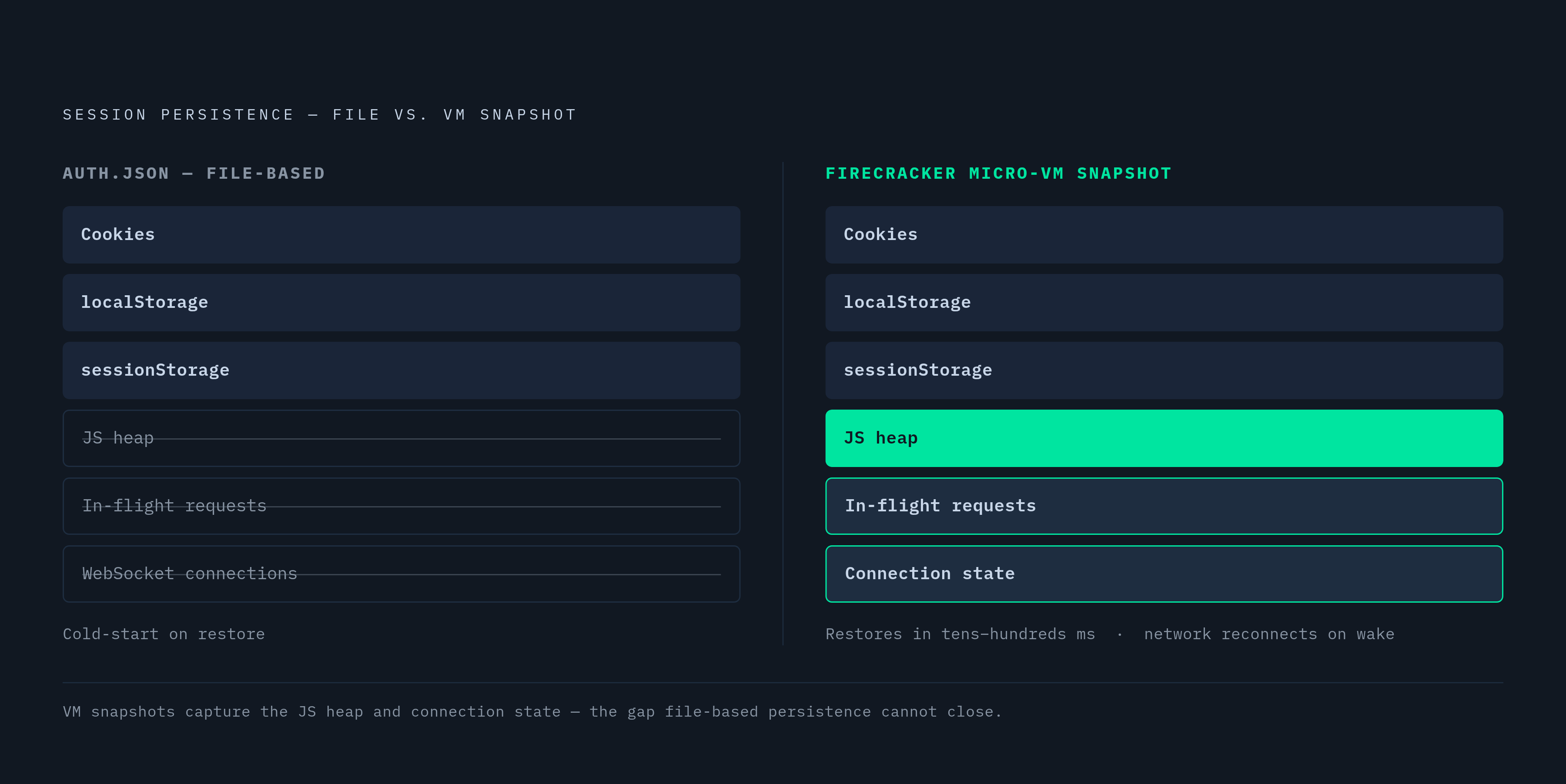
A snapshot of a running browser is best understood the way a saved game state works, and it isn't a description of where the browser was: it's the actual state the agent resumes from, memory and all. That distinction is what separates VM-level snapshotting from file-based session persistence, and it's a difference in kind, not degree.
With a micro-VM, the browser doesn't need to cold-start from nothing. The VM can be snapshotted while the browser sits in a post-login state and restored in tens to hundreds of milliseconds, picking up exactly where it left off, including in-memory browser state that has no file-based equivalent to serialize into. File-based persistence saves cookies and storage. VM snapshot persistence saves the entire browser process memory: connection state, in-flight requests, the JavaScript heap. That's a meaningfully stronger form of continuity than anything a cookie jar can offer.
The gap shows clearly with WebSocket and long-poll connections, which some authenticated workflows depend on and which simply can't be reconstructed from saved cookies alone. VM-level restore preserves the browser process state and authentication context in a way file-based restore can't match, though the underlying network connections themselves still need to reconnect once the VM wakes. Browser launch configuration, flags, extensions, proxy settings, stealth settings, gets preserved in the snapshot as well, with no need to rebuild any of that initialization logic on every run.
The speed of the restore path matters as much as the snapshot itself. A VM that wakes in well under a second can sit idle and cheap between tasks, then turn active and fast the moment work shows up. This property is what makes deploying one dedicated agent per user economically realistic, and it's the same property that makes browser-session persistence operationally workable, not just a theoretical nicety.
The idle cost problem: why most agents should pay for storage, not running browsers
You might think the way to keep a browser's session alive is to keep its container running between tasks, but that's exactly the wrong instinct economically. Keeping a browser process alive the whole time pays compute rates for idle time, and idle time is most of what an agent's lifecycle actually consists of.
Most agents spend the bulk of their time waiting: for a user request, for a scheduled trigger, for a long LLM reasoning step to finish somewhere else in the pipeline. A browser process kept alive purely to preserve its session burns CPU and memory through all of that waiting, whether or not any work is actually happening.
The snapshot model breaks the link between "session stays alive" and "compute keeps running." When an agent goes idle, its VM gets snapshotted and paused, and the session persists in storage while no process runs. The agent then pays storage rates during the idle stretch, which run far below compute rates, and when real work arrives, it wakes to a fully live browser session. That shift is what makes dedicating a persistent browser session to every individual user financially workable, rather than forcing a platform to pay continuous compute costs for every user's idle agent.
The billing model matters as much as the technical design. If a provider bills wall-clock CPU and memory, it charges for the entire idle stretch, no matter how little the agent is actually doing. A provider built around snapshotting, charging only for storage while the agent sleeps, produces a cost profile that looks completely different for any workload with a low duty cycle, which describes most agents built to sit and wait for the next thing to do.