Why Serverless Event Loops Cannot Hold the Causal Thread of an Autonomous Agent Run
Serverless functions lose the causal thread autonomous agents need to run correctly.
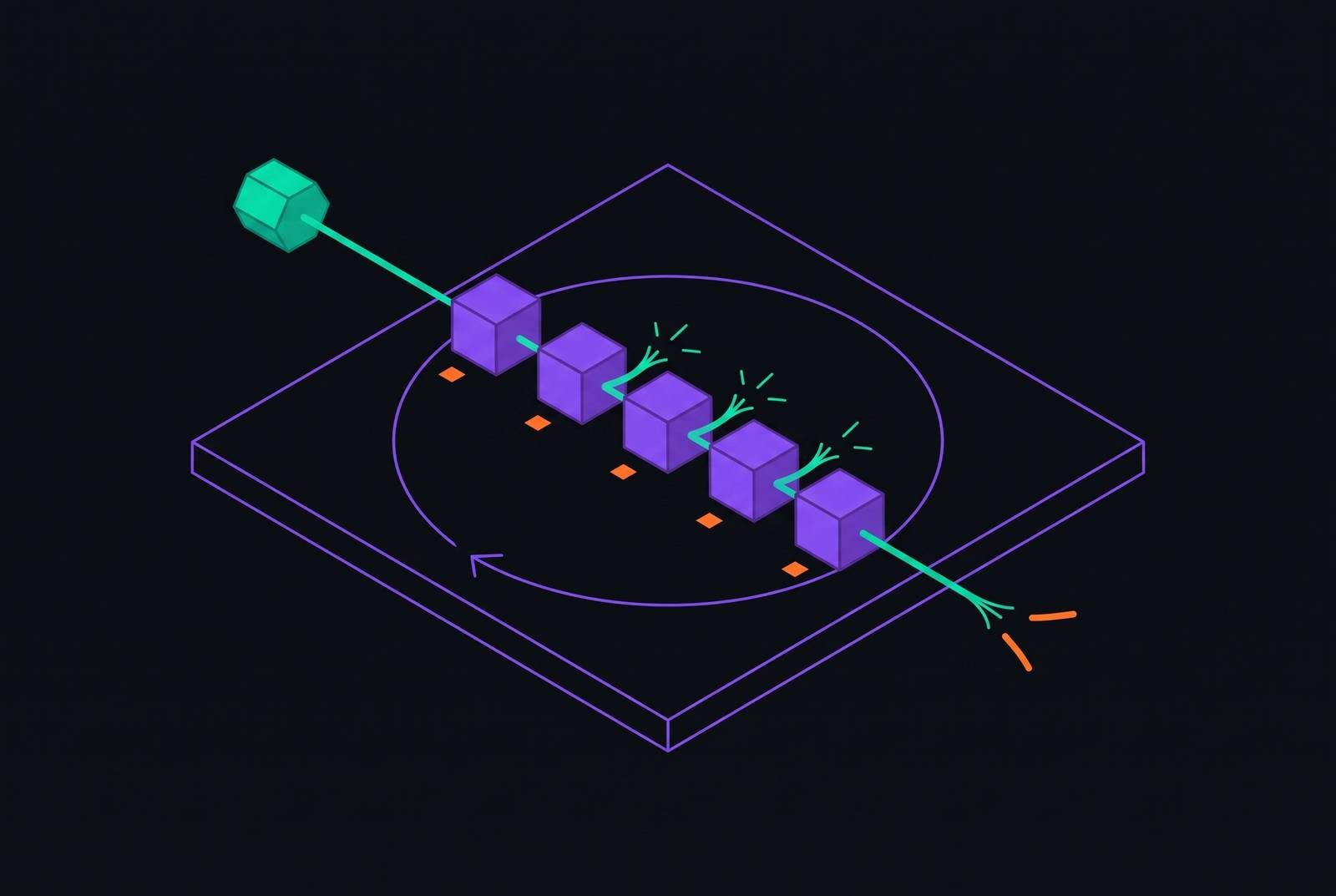
Serverless functions alone cannot keep an autonomous agent run’s causal thread intact because invocation-local state may be lost after the call. Persistent AI agent infrastructure preserves the workspace, while durable orchestration records progress and separates waiting from computing. The architectural requirement is continuity of execution state and authority at commit time.
What a causal thread actually is in an autonomous agent run
An autonomous agent run is a chain of dependent decisions. Each action depends on state accumulated through prior steps, including tool outputs, intermediate files, retry counts, approval status, and the current plan version. The goal is a different kind of state. It can remain open for days, while the causal thread records exactly what the agent has done and what its next action depends on.
A tool call may produce an artifact that changes the plan, while a later validation must refer to that version of the artifact. An external signal may then decide whether the run goes on. Order is part of the meaning of that state. Without a deterministic record of completed effects, a retry cannot tell whether an action has already run or still needs to run.
Yuxiang Peng and Xiaodi Wu’s 2026 paper, Stateful Governance for Concurrent Agentic Systems, adds a further requirement. The budget used, inventory held, and approval status can change between authorization and commitment. The thread therefore includes more than recoverable memory. It must connect the next effect to the live policy state that permits it.
How serverless execution is designed, and what it discards at invocation end
Serverless execution treats compute as disposable. An event arrives, code runs in an isolated environment, and that environment can disappear after the invocation. State that must survive belongs elsewhere, including a database, an object store, a queue, or a workflow service. This is a deliberate division of responsibility. It supports unpredictable bursty traffic, short-lived stateless transforms, and cost-zero at idle for simple workloads.
The consequence is that invocation-local state has no continuity guarantee. In-memory variables, local files, open connections, partially constructed tool outputs, and accumulated runtime context cannot serve as the durable foundation of the next call. A warm environment does not change that contract. If a coding agent must clone a repository and install dependencies, a cold invocation must rebuild an environment that was previously ready.
A complex reasoning step or a tool call blocked on a slow external API can reach the invocation limit before progress is committed. Extending the window changes how much work fits inside it, but not who owns state afterward. These choices work well for independent transformations because each invocation can end without keeping an execution environment for the next one.
Where the thread breaks when AI agents run on serverless functions
The most consequential failures occur when execution appears to continue normally despite a missing dependency. An agent’s plan can span several invocations, while an intermediate step fails silently or returns a different outcome after a retry. Later steps may then use a premise that is no longer true. The plan has forked without an explicit decision. Unless the relevant dependency was preserved and checked, the resumed agent has no invocation-local evidence that anything changed.
Stale authorization can also break the link between permission and effect. Peng and Wu identify this as the central governance failure in concurrent agentic systems. An action authorized when there was budget left or approval was still valid may commit after that condition changes. Discarding the process does not itself prove a violation, but a later invocation cannot treat the earlier decision as current authority merely because it was recorded.
Environment loss produces a more visible failure of continuity. A checked-out repository, installed native dependency, or warm browser profile must be reconstructed if it existed only in the discarded environment. A long wait for approval can leave the agent with an environment to rebuild even when it has no new reasoning to do.
A longer timeout cannot fix all of these problems. An agent may complete six tool calls, wait overnight for human approval, and then revise its plan. That sequence must be able to run beyond one invocation window. It needs a mechanism that preserves progress through the wait and distinguishes completed work from work still pending.
What durable orchestration restores — and what it cannot
A Step Functions Standard Workflow can run for up to a year, with a callback task that pauses until a human or external process returns a task token. No compute needs to run during that wait. The goal stays active even when the process that does the work has stopped.
Lambda durable executions can likewise span up to a year by checkpointing progress across many invocations. Their waits suspend the function and stop compute charges. By externalizing progress, durable orchestration restores the sequence that disposable execution alone cannot retain and allows a long-lived goal to use short-lived compute.
The remaining gap is narrower than lost workflow history. A record that a repository was checked out does not itself preserve the checkout, its installed native dependencies, build artifacts, warm cache, or browser profile. Those are properties of the workspace. When rebuilding them is slow, expensive, or unsafe, replaying recorded progress is not equivalent to resuming the environment that produced it.
Runtime planning adds a separate qualification to pre-wired workflows. A model may revise its plan, choose another tool, or delegate a step after receiving new evidence, so the complete path cannot always be encoded in advance. Progress tracking and workspace continuity remain distinct responsibilities, even when durable orchestration successfully separates waiting from computing.
Why stateful governance requires the thread to be unbroken at effect time, not just reconstructable
For consequential operations, preserving history is only part of correctness. An agent issuing a refund, reserving inventory, provisioning cloud resources, or initiating a transfer needs authority at the moment the effect commits. An earlier approval may no longer be valid. Recovering the decision afterward explains what the agent believed, but does not establish that the effect was permitted when it occurred.
Peng and Wu call the required condition “policy-state serializability.” Committed effects must be explainable as authorized against the policy state immediately before they occur. Budget availability, inventory status, and approval flags must participate in the decision that governs the effect.
Request-local governance leaves that connection incomplete when it evaluates a request, returns a decision, and lets the framework apply the effect separately. The trust boundary stops before the consequential operation. The framework may lose or replay the effect without the policy engine’s knowledge. Concurrency makes the gap sharper because two agents can each receive valid authorization against an observed shared budget or inventory pool, then both commit in violation of the shared constraint.
A persistent process is not, by itself, a solution to shared-state coordination. The governing requirement is that live, mutable policy state remain authoritative through commitment. Persistence supports that requirement, while effect coordination gives it force. Agents that handle money, reservations, or access grants need more than stateless invocation chains to work correctly, even if those chains keep a full record of earlier approvals.
What persistent, isolated infrastructure actually provides that serverless cannot
A persistent workspace keeps the agent’s working environment available across steps. The repository, dependencies, browser profile, and build artifacts stay ready to use without having to be rebuilt from instructions. This changes the meaning of resumption. The agent continues from an existing workspace instead of spending each cold start recreating the conditions under which its previous decisions were made.
Hardware-level isolation addresses a different requirement within that workspace. AI-generated or user-supplied code needs an execution boundary that separates it from other sessions. Amazon Bedrock AgentCore Runtime’s microVM compute type assigns each session its own isolated environment, boots quickly, and scales memory on demand without downtime. Its session model is one session per microVM. That model belongs to the microVM compute type, one of two supported compute types.
Snapshot-restore makes workspace preservation compatible with disposable active compute. A microVM can reach a ready state, snapshot its memory and block device state, and restore subsequent instances from that snapshot. This changes startup latency without weakening the isolation boundary. The system restores the environment itself, with idle persistence charged as storage.
AgentCore’s session ID acts as a continuity handle, while compute stops after inactivity, with 15 minutes as the default, and new compute is provisioned on the next invocation using that ID. The handle alone does not show that the workspace survives.
Profound uses Lambda MicroVMs to bring instant-start AI marketing agents to thousands of customers and launches several hundred thousand MicroVMs per month. This shows how the snapshot-restore pattern works across a large fleet. For governance, a live microVM session also provides a process that can retain budget, inventory, and approval state through commitment. To meet the paper’s correctness condition, the process must still coordinate shared state and effects because isolation alone cannot prove that an authorization is still valid.
How the per-agent, per-user deployment model becomes economically viable once the workspace persists
The cost of persistence depends on what happens while compute is idle as well as what it costs while it runs. Most agents are idle most of the time, waiting for approval, an external event, or the next user session. When the harness snapshots full execution state to durable storage and terminates the process, compute drops to zero while the saved state incurs storage cost.
When the next signal arrives, the harness restores the snapshot in milliseconds. The agent can wait with its process stopped and then return without a full environment rebuild. This is the idle-cost inversion that supports per-user deployment.
Fleet economics depend on that distinction because each additional agent adds periods of waiting as well as periods of work. A per-agent price that appears affordable for a small deployment can become untenable when it includes idle compute across a large fleet. Storage-priced rest removes that particular burden. It prevents the duration of a user’s relationship with an agent from becoming the duration of a continuously billed process.
The 2026-07-28 MCP specification shift places stateless request/response behavior at the tool-call layer while the agent’s execution environment holds state. Tool integrations can scale horizontally, while workspace ownership and billing remain attached to the agent.
Cheap workspace persistence makes each user’s agent a viable product unit, retaining that user’s files, credentials, browser sessions, and memory between sessions. This is closer to personal software than to a shared stateless service. For infrastructure selection, the decisive comparison is therefore not whether compute can stop. It is whether the system can stop compute without losing the workspace, the sequence of completed effects, or the authority needed for the next action.